WAter
A Workload-Adaptive Knob Tuning System based on Workload Compression
Project Background
Selecting appropriate values for the configurable parameters (knobs) of a DBMS is a significant challenge. Recent machine learning (ML)-based tuning systems have shown strong potential, but their practical adoption is often limited by the high tuning cost. This cost arises from two factors: (1) the system needs to evaluate a large number of configurations to identify a satisfactory one, and (2) for each configuration, the system must execute the entire target workload on the DBMS, which is both time-consuming and resource-intensive.
Existing studies have primarily addressed the first factor by improving sample efficiency, that is, by reducing the number of configurations that must be evaluated. The second factor, improving runtime efficiency by reducing the time required for each evaluation, has received limited attention and remains underexplored.
System Overview
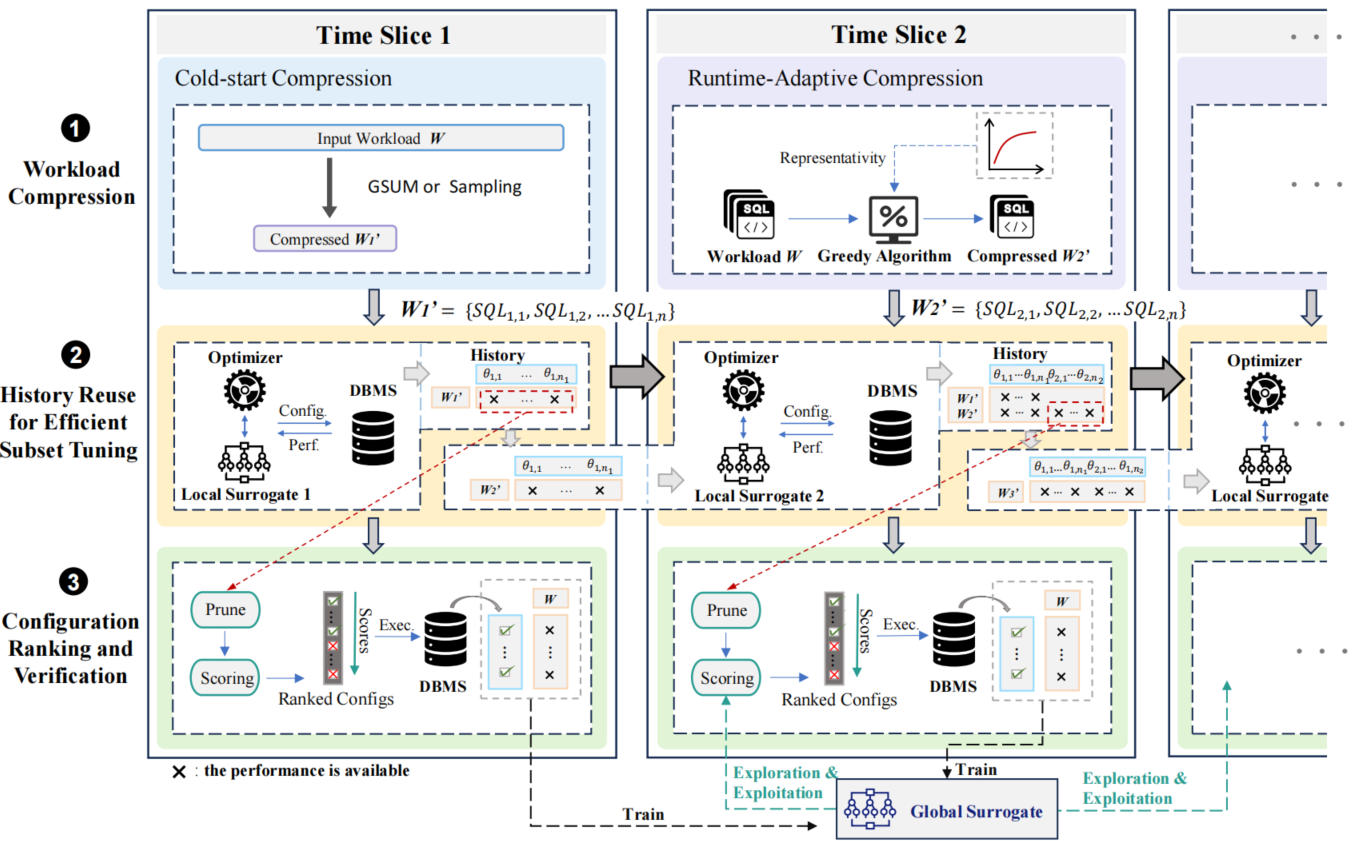
WAter is a runtime-efficient, workload-adaptive knob tuning system that finds near-optimal configurations at a fraction of the tuning cost compared with state-of-the-art methods. Instead of repeatedly replaying the entire target workload, WAter divides the tuning process into a sequence of time slices and evaluates only a small subset of queries from the workload in each slice. Each time slice involves three steps:
- 📌 Workload compression: Given an input workload, WAter greedily compresses the workload based on runtime statistics to maximize representativity. We design a query-level metric and a novel Greedy Algorithm that continually refines the query subset (e.g., removing uninformative queries and adding promising ones) as tuning progresses.
- 📌 Subset tuning with history reuse: WAter organizes and reuses the tuning history collected on other subsets to bootstrap the local surrogate model of the tuner assigned to the current subset, achieving efficient subset tuning.
- 📌 Configuration verification: WAter uses a hybrid scoring mechanism, built upon a global surrogate model, to balance exploitation and exploration and to select the most promising configurations for evaluation on the entire workload.
Experimental Results
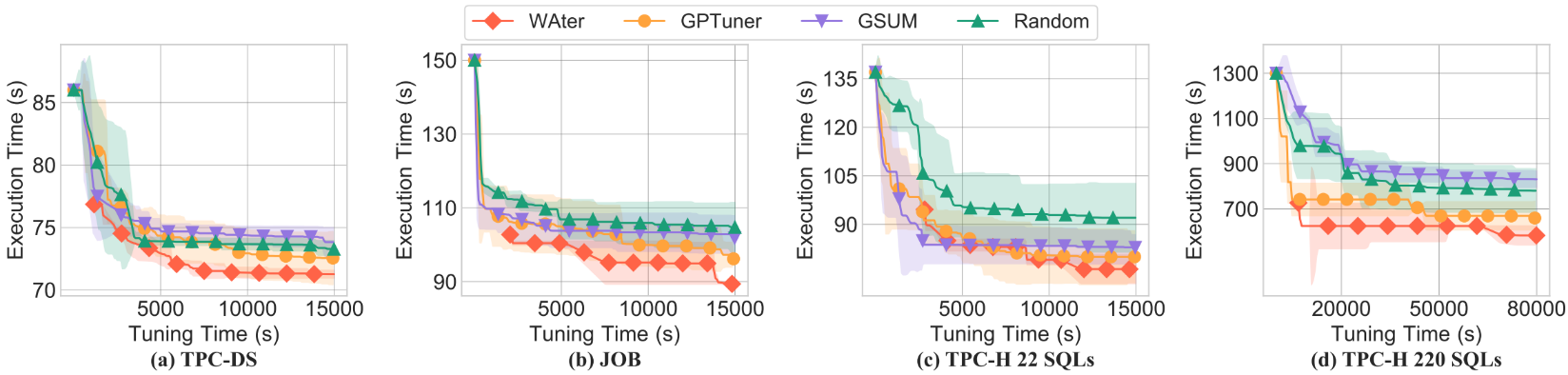
We evaluate WAter across different workloads (e.g., TPC-H, TPC-DS, JOB, DSB, and SQLStorm) and compare it with state-of-the-art approaches. WAter identifies the best-performing configurations with up to 73.5% less tuning time and achieves up to 16.2% higher performance than the best-performing alternative. We also demonstrate WAter’s robustness across different hardware platforms and optimizers, as well as its scalability across database sizes.
Publication
Yibo Wang, Jiale Lao, Chen Zhang, Cehua Yang, Jianguo Wang, and Mingjie Tang. WAter: A Workload-Adaptive Knob Tuning System based on Workload Compression. Proceedings of the VLDB Endowment (VLDB ‘27).
Come and Learn More!
For more information and hands-on experience of WAter, please visit our Github Repo! [WAter]